Do you often wake up tired after a full night’s sleep? Poor airway health can be the reason for your unrestful nights. Airway health is foundational to overall well-being, since problems with breathing, especially during sleep, affect energy, heart health, and even cognitive performance. They can also cause more insidious dental health issues that are often missed or simply overlooked, like mouth breathing, dental caries, periodontal disease, malocclusion, teeth grinding, and temporomandibular joint disorder. A skilled dentist recognizes poor airway health as the cause of these conditions and will typically use a combination of assessment techniques and diagnostic tests to confirm the root cause of your problem.
What is a “bad airway”?
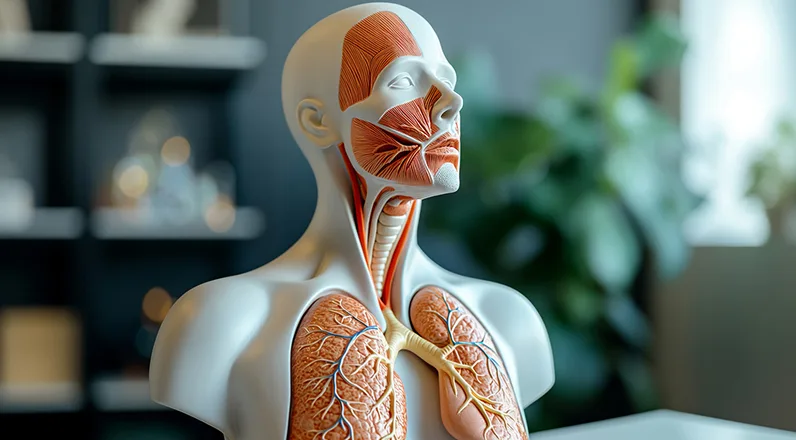
Your airways are divided into two major parts: the upper airway, composed of your nose, mouth, throat (pharynx), and voice box (larynx), and the lower airways, which are the windpipe (trachea) and the small airways in your lungs. A bad airway refers to any structural or functional anomaly in your airway that impairs your ability to breathe normally; it could be a deviated nasal septum, enlarged turbinates (bony structures inside the nasal cavity), high narrow palate, large tongue, or narrow airways. A bad airway can have major effects on your dental and systemic health.
Dental implications of bad airways
Try to always breathe through your nose. Nose breathing improves the quality of the inspired air by humidifying it, cleaning it from small dust particles, and warming it to match the body’s temperature. Bad airways make it difficult to breathe through your nose; instead, you start mouth breathing, losing all these benefits. Moreover, air will dry oral secretions and reduce the production of saliva that normally moisturizes the mouth and reduces its acidity. The resulting dry, acidic oral environment encourages the overgrowth of harmful bacteria, disrupting your microbiome and causing caries and dental infections like periodontitis. On top of that, chronic mouth breathing will change your airway structure, contributing to conditions like chronic sinusitis, malocclusion, teeth grinding, and temporomandibular joint disorder of the jaw joint.
The effect of bad airways on your systemic health
Sleep apnea, which is a manifestation of bad airways, is linked to high blood pressure, diabetes, obesity, high cholesterol, heart failure, Alzheimer’s, anxiety, and depression. During the apnea episodes, your brain doesn’t get enough oxygen; this triggers the body’s fight-or-flight response and activates the sympathetic nervous system, which leads to the secretion of large amounts of adrenaline. The chronic activation of the sympathetic nervous system will eventually cause high blood pressure and other cardiovascular diseases. It will also activate your immune system, putting your body in a state of chronic inflammation. In addition, the chronic lack of oxygen reduces your brain performance, impairing memory and cognition.
Poor airway health in children
Airway health issues often arise early in childhood, mainly resulting from hypertrophied adenoids, tonsils, or childhood obesity. This leads to pediatric obstructive sleep apnea (OSA). Similar to the adult variant, pediatric OSA causes snoring and mouth breathing, unrestful sleep, low energy, and daytime sleepiness and leads to dental, metabolic, and cardiovascular diseases. Additionally, OSA in children hinders brain development, resulting in lower IQ, learning disabilities, ADHD, depression, and anxiety.
How to diagnose and manage it?
Upon recognizing some or all of these symptoms, your doctor or dentist can perform a series of clinical tests, imaging assessments, and sleep studies to confirm the diagnosis. These include:
- Cone-Beam Computed Tomography (CBCT) Scans: a 3D imaging modality that visualizes the dimensions of your upper airways and is often used for assessment of OSA.
- Mallampati Score Assessment: A clinical grading system used by dentists to quantify the risk of airway obstruction.
- Cephalometric Analysis: A method that evaluates oral structures and how they affect airway health.
- Sleep studies: Based on your symptoms and your test results, a sleep study may be indicated for a definitive diagnosis. And if you can’t spare the time for a formal sleep study, a more convenient alternative is an at-home sleep test where you wear a ring that records your breathing patterns and oxygen levels in your blood while you sleep in the comfort of your bed.
By using these assessment tools, the healthcare professional can identify the exact cause of your airway problems and address it using one or more of these methods:
- Using personalized dental appliances and oral devices like a palatal expander or mandibular advancement devices, these improve the structure and position of your palate and jaw and prevent airway collapse during sleep.
- Myofunctional Therapy, a series of exercises designed to strengthen your facial, oral, tongue, and airway muscles. It improves the tongue posture, corrects mouth breathing, and encourages nose breathing.
- Mouth taping: Although not appropriate for everyone, it can prevent mouth breathing in selected patients.
Combined with weight loss and nose breathing exercises, these noninvasive interventions can significantly improve your breathing and fix your bad airway so you can get restful sleep.
Airway problems are more common than you think, and their symptoms can be sneaky, fitting themselves into your daily routine without you noticing. So if you’re having trouble with unrestful sleep, or if you feel sleepy and out of focus all the time, get your airway health checked now; the solution for your problems could be much simpler than you think.
References
- Raanan Arens, Carole L. Marcus, Pathophysiology of Upper Airway Obstruction: a Developmental Perspective, Sleep, Volume 27, Issue 5, August 2004, Pages 997–1019,https://doi.org/10.1093/sleep/27.5.997
- Dieltjens M, Vanderveken O. Oral appliances in obstructive sleep apnea (https://www.ncbi.nlm.nih.gov/pmc/articles/PMC6956298/). Healthcare (Basel). 2019;7(4):141. Published 2019 Nov 8. Accessed 4/19/2024.
- Impact of airway dysfunction on dental health Juliette Tamkin https://pmc.ncbi.nlm.nih.gov/articles/PMC6986941/
- Michael Blechner, Ariel A. Williamson, Consequences of Obstructive Sleep Apnea in Children, Current Problems in Pediatric and Adolescent Health Care, Volume 46, Issue 1, 2016, Pages 19-26, ISSN 1538-5442,https://doi.org/10.1016/j.cppeds.2015.10.007.