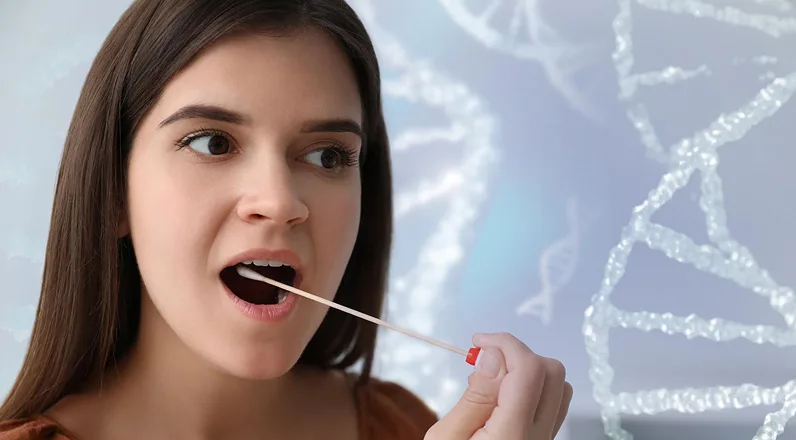
How genetics shape your oral health
Ever met someone who treats their teeth like an afterthought; chews sugar like it’s a food group, flosses once a year and still walks away from the dentist with a clean bill? Meanwhile, you’re brushing, rinsing, praying… and still need another filling. That’s not just bad luck; it’s genetics. Turns out, the battle against cavities and gum disease doesn’t start in the bathroom. It starts in your DNA. Genes do a lot more than decide your eye color or whether cilantro tastes like soap. They also control your enamel’s strength, how well your saliva fights off bacterial invaders, and whether your gums go to war at the first sign of plaque.
Some key genetic factors include:
- Enamel strength: Some people inherit titanium-grade enamel. Genes like AMELX and ENAM influence how durable your enamel is, and even slight variations can mean the difference between “resistant” and “vulnerable.”
- Saliva production and quality: Saliva does more than just rinse your mouth. It neutralizes acid and contains natural defenses. Its quality and quantity are also written in your genetic code. If your mouth feels dry often, your genes might be part of the reason.
- Gum disease risk: Certain immune-related genes can dial your body’s inflammatory response up or down. That means the same amount of plaque could trigger aggressive gum disease in one person and barely a reaction in another.
- Your genome controls your taste in food too; the TAS2R38 gene affects how we perceive bitterness. People who are more sensitive may avoid certain veggies and lean toward carbs or sweets. So if you’re not paying attention, your aversion to bitter greens might be shaping a carb-loaded, cavity-friendly diet.
So yes, bad teeth do run in families. But don’t panic; your genes may stack the deck, but they don’t deal the hand. That’s where lifestyle and epigenetics step in to give you a fighting chance.
Your DNA isn’t your destiny
DNA is more like a rough draft. Epigenetics is where things get interesting. It’s the science of how your environment and choices flip certain genetic “switches” on or off. So even if you were born with an enamel disadvantage or an inflammatory gum gene, your lifestyle can calm things down.
What flips the switch?
Your body is constantly responding to cues from your environment, and those cues can leave lasting marks on how your genes express themselves. Here are a few examples:
- Stress: Chronic stress can activate inflammation-related genes, making your gums more reactive and less resilient.
- Diet: A nutrient-poor diet can suppress helpful genes or fail to support those that build and repair tissue. Low folate or B12, for instance, might make gum disease more likely, especially if you already have a genetic variant (like MTHFR) that limits how well you process these vitamins.
- Smoking: Smoking can chemically alter your DNA’s epigenetic markings; essentially flipping switches that activate tissue-damaging pathways and disable protective ones.
- Sleep: Poor sleep and fatigue impair your immune system and can indirectly influence how your body responds to oral bacteria.
That’s why identical twins, who share the exact same DNA, can end up with very different oral health outcomes. And this is where personalized care comes in; because once you know your risks, you can actually do something about them.
Tailored Care for Your Genetic Blueprint
As we begin to understand just how much our genes shape our oral health, it’s clear that the old one-size-fits-all approach to dental care doesn’t work anymore. What works for one person could be overkill, or completely inadequate, for someone else. Instead of treating symptoms in isolation, personalized care looks at the full picture: your genetic risk factors, family history, microbiome profile, dietary patterns, and lifestyle habits. It’s a smarter, more precise way of preventing problems before they start, and managing them more effectively when they do.
We’ve adopted this approach for years. We don’t just ask about flossing; we ask about stress, sleep, nutrient intake, and family patterns. We’ve seen how patients with mild symptoms but high-risk genetics benefit from early interventions, while others with good genes can maintain oral health with simpler routines. We also offer guidance on newer tools like oral microbiome analysis or genetic screenings for enamel-related or inflammatory markers. Not everyone needs them, but when they’re useful, they help us make more informed decisions. Think of it as upgrading from guesswork to strategy.
Your smile isn’t just a product of luck; it’s a reflection of biology, behavior, and care. And with the right strategy, you can work with your DNA, not against it. If you’re curious what that kind of care could look like for you, we’re ready when you are.
References
Tulek A, Mulic A, Runningen M, Lillemo J, Utheim TP, Khan Q, Sehic A. Genetic Aspects of Dental Erosive Wear and Dental Caries. Int J Dent. 2021 Jul 12;2021:5566733. doi: 10.1155/2021/5566733. PMID: 34335772; PMCID: PMC8292068.https://pubmed.ncbi.nlm.nih.gov/34335772/
Melis M, Atzori E, Cabras S, Zonza A, Calò C, Muroni P, Nieddu M, Padiglia A, Sogos V, Tepper BJ, Tomassini Barbarossa I. The gustin (CA6) gene polymorphism, rs2274333 (A/G), as a mechanistic link between PROP tasting and fungiform taste papilla density and maintenance. PLoS One. 2013 Sep 9;8(9):e74151. doi: 10.1371/journal.pone.0074151. PMID: 24040192; PMCID: PMC3767652.https://pubmed.ncbi.nlm.nih.gov/24040192/
Thampan N, Ramya R, Swarnalakshmi R, Rajkumar K, Savithri S, Divyalakshmi G. Analysis of ENAM gene single-nucleotide polymorphism rs3796704 with caries susceptibility in young adult Tamil population. J Oral Maxillofac Pathol. 2021 May-Aug;25(2):226-231. doi: 10.4103/0973-029X.325119. Epub 2021 Aug 31. PMID: 34703114; PMCID: PMC8491349.https://pubmed.ncbi.nlm.nih.gov/34703114/
Khouly I, Braun RS, Ordway M, Aouizerat BE, Ghassib I, Larsson L, Asa’ad F. The Role of DNA Methylation and Histone Modification in Periodontal Disease: A Systematic Review. Int J Mol Sci. 2020 Aug 27;21(17):6217. doi: 10.3390/ijms21176217. PMID: 32867386; PMCID: PMC7503325.https://pubmed.ncbi.nlm.nih.gov/32867386/
Asa’ad F, Pelanyte G, Philip J, Dahlin C, Larsson L. The Role of Epigenetic Functionalization of Implants and Biomaterials in Osseointegration and Bone Regeneration-A Review. Molecules. 2020 Dec 12;25(24):5879. doi: 10.3390/molecules25245879. PMID: 33322654; PMCID: PMC7763898.https://pubmed.ncbi.nlm.nih.gov/33322654/