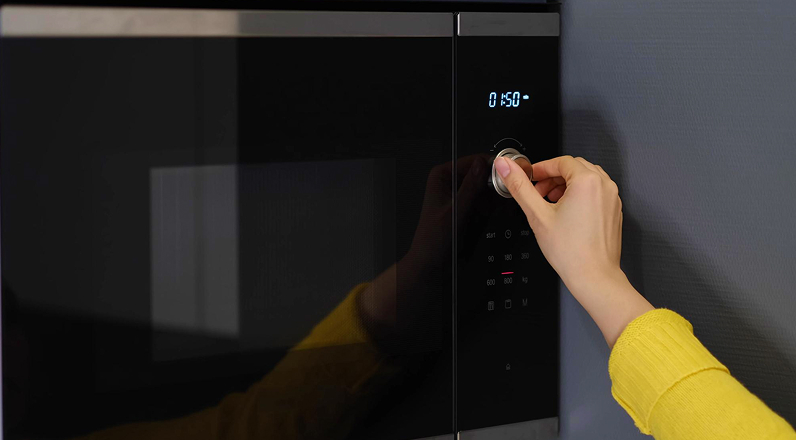
You will find a microwave oven in almost every home. Press a button, and yesterday’s soup is ready and steaming in seconds. Popular safety guidelines say the appliance is shielded tightly; any leaking radiation diminishes beyond a few centimeters. But laboratory evidence suggests that daily exposure to small doses of microwaves from small leaks adds up and, over the years, can burden our systems.
A microwave oven produces radiofrequency waves at roughly 2.45 GHz. Metal walls bounce the waves around until they reach the food, where water molecules absorb the energy from these waves and convert it to heat. Two points matter for health:
- Door integrity. Chips, warping, grime, and bent latches compromise the shield that blocks radiation.
- Distance decay. Wave intensity falls off quickly. But the closer you are, the more exposure you get.
Everyday ambient radiation from Wi-Fi routers or cell towers is another source for microwaves, but most of the daily exposure comes from the oven’s concentrated bursts, particularly when someone hovers nearby while it runs.
The immediate effect of heavy exposure to microwave radiation is thermal injury; this is particularly evident in tissues that dissipate heat poorly, like the lens, ovaries, and testicles. This type of injury manifests in the form of cataracts and fertility issues. But thermal injury is not the only concern.
The non-thermal effects of microwave radiation exposure
Evidence now points to biological effects that occur without any detectable heating:
- Brief microwave bursts induce electrical microcurrents in tissues, changing ion channel behavior.
- The vibration of water molecules in tissues can break off bonds and create reactive oxygen species.
- Radiation affects the behavior of calcium ions inside cells, which disrupts multiple signaling pathways.
These findings appear in cell cultures and animal models exposed to leakage-level intensities similar to standing twenty centimeters from a worn appliance.
Mitochondrial health
Microwave-triggered electrical agitation can interrupt electron flow in mitochondria, releasing excess superoxide radicals. Studies on rat heart and brain tissue showed swollen mitochondria and elevated lipid peroxidation markers after chronic low-level exposure. Levels of antioxidant enzymes such as superoxide dismutase were low, suggesting depleted defenses.
Brain function and sleep quality
Controlled trials show electroencephalogram changes when volunteers spend repeated evenings near an active 2.45 GHz emitter. Participants reported lighter sleep, vivid dreams, and morning drowsiness, even though core body temperature didn’t change. Children, whose skulls are thinner, may absorb proportionally higher doses. Longitudinal research correlates high cumulative microwave exposure in youth with subtle memory and attention deficits in later school years.
Effect on endocrine health and fertility
Testicular and ovarian cells contain high water content and delicate mitochondrial networks. Studies confirmed that exposure to microwave radiofrequency fields reduces sperm motility and viability and disrupts follicular development in females. Phones receive the most blame, but microwave ovens share some responsibility. Other hormonal systems were also involved, as cortisol spikes were observed in microwave-exposed rodents.
Cancer risk
Lab-based studies have documented that chronic leakage from aging microwave ovens can cause DNA strand breaks and slow repair in epithelial tissue, a pattern that encourages early tumor formation. Epidemiologic surveys link heavy oven use in kitchens with a slight increase in breast and thyroid cancer risks, signaling caution until more comprehensive research settles the debate.
Heavy exposure from industrial and military sources
Commercial food processors, ceramic dryers, and radar arrays operate at high levels, magnitudes above the kitchen appliance. Occupational records list cataracts, deep tissue burns, and cardiac rhythm anomalies among technicians working near poorly shielded emitters.
Your action plan
Reduce exposure.
- Use stovetop steaming or toaster-oven warming whenever practical.
- Keep at least sixty centimeters between your body and the oven door during operation; this cuts leakage wave intensity by roughly ninety percent.
- Replace any unit with rusted mesh, a warped frame, or a flickering door indicator light .
- Use speaker setting or wired earbuds for phone calls so combined microwave and cellular exposure to the head stays low.
Support your systems.
- Incorporate antioxidant-rich foods in your diet: blueberries, rosemary, dark leafy greens, and raw cacao.
- Ensure sufficient daily magnesium intake through diet or supplementation.
- Consider evening melatonin, supporting circadian rhythm and free-radical clearance.
Track your biomarkers.
Regular mitochondrial stress assays, lipid peroxide levels, and other inflammation markers will help track your exposure to environmental stressors, including microwave radiation.
A community-level approach
Regulatory bodies only consider acute thermal injuries when setting exposure limits despite the accumulating scientific evidence of non-thermal findings. Industrial standards for microwave radiation-based devices should be rethought, but until that happens, choosing different cooking methods, inspecting appliance seals, and sleeping in a router-free bedroom cost little yet may avoid some long-term dreaded outcomes.
Microwave ovens provided convenience. But convenience sometimes comes at hidden costs. Evidence linking chronic, low-level leakage to oxidative stress, sleep disturbance, reproductive issues, and possible carcinogenesis continues to mount, even though mainstream agencies view the data as inconclusive. We must consider early warnings; waiting for absolute consensus can leave people living for decades in a potentially toxic environment. Treat microwave radiation like any environmental factor that should be controlled. Leftovers may take two minutes on the stove, yet that could spare your mitochondria the steady exposure to 2.45 GHz radiation.
References
Dondoladze K, Nikolaishvili M, Museliani T, Jikia G, Zurabashvili D. IMPACT OF HOUSEHOLD MICROWAVE OVEN NON-IONIZING RADIATION ON BLOOD PLASMA CORTISOL LEVELS IN RATS AND THEIR BEHAVIOR. Georgian Med News. 2020 Sep;(306):132-137. PMID: 33130660.https://pubmed.ncbi.nlm.nih.gov/33130660/
Chauhan P, Verma HN, Sisodia R, Kesari KK. Microwave radiation (2.45 GHz)-induced oxidative stress: Whole-body exposure effect on histopathology of Wistar rats. Electromagn Biol Med. 2017;36(1):20-30. doi: 10.3109/15368378.2016.1144063. Epub 2016 Jun 30. PMID: 27362544.https://pubmed.ncbi.nlm.nih.gov/27362544/
Inalöz SS, Aksünger A, Sari I, Daşdağ S, Deveci E. Do microwave ovens affect the eyes? Jpn J Ophthalmol. 1997 Jul-Aug;41(4):240-3. doi: 10.1016/s0021-5155(97)00047-6. PMID: 9304438.https://pubmed.ncbi.nlm.nih.gov/27362544/
Shahin S, Banerjee S, Singh SP, Chaturvedi CM. 2.45 GHz Microwave Radiation Impairs Learning and Spatial Memory via Oxidative/Nitrosative Stress Induced p53-Dependent/Independent Hippocampal Apoptosis: Molecular Basis and Underlying Mechanism. Toxicol Sci. 2015 Dec;148(2):380-99. doi: 10.1093/toxsci/kfv205. Epub 2015 Sep 22. PMID: 26396154.https://pubmed.ncbi.nlm.nih.gov/26396154/
Pall ML. Microwave frequency electromagnetic fields (EMFs) produce widespread neuropsychiatric effects including depression. J Chem Neuroanat. 2016 Sep;75(Pt B):43-51. doi: 10.1016/j.jchemneu.2015.08.001. Epub 2015 Aug 21. PMID: 26300312.https://pubmed.ncbi.nlm.nih.gov/26300312/
Deshmukh PS, Megha K, Banerjee BD, Ahmed RS, Chandna S, Abegaonkar MP, Tripathi AK. Detection of Low Level Microwave Radiation Induced Deoxyribonucleic Acid Damage Vis-à-vis Genotoxicity in Brain of Fischer Rats. Toxicol Int. 2013 Jan;20(1):19-24. doi: 10.4103/0971-6580.111549. PMID: 23833433; PMCID: PMC3702122.https://pmc.ncbi.nlm.nih.gov/articles/PMC3702122/
Bijlsma N, Conduit R, Kennedy G, Cohen M. Does radiofrequency radiation impact sleep? A double-blind, randomised, placebo-controlled, crossover pilot study. Front Public Health. 2024 Oct 29;12:1481537. doi: 10.3389/fpubh.2024.1481537. PMID: 39534742; PMCID: PMC11554657.https://pubmed.ncbi.nlm.nih.gov/39534742/
Kim S, Han D, Ryu J, Kim K, Kim YH. Effects of mobile phone usage on sperm quality – No time-dependent relationship on usage: A systematic review and updated meta-analysis. Environ Res. 2021 Nov;202:111784. doi: 10.1016/j.envres.2021.111784. Epub 2021 Jul 30. PMID: 34333014.https://pubmed.ncbi.nlm.nih.gov/34333014/